How to Find Local Businesses That Need Websites (2026 Guide)
Updated May 2026
Roughly 27% of US small businesses still have no website, which works out to around 8 million businesses according to industry surveys and US Chamber of Commerce data. Every one of them is a potential web design client, and most of them don't even realize how much business they're losing to competitors who show up in search.
For an agency or freelancer, these are some of the easiest clients you'll ever win. The need is obvious, the pitch writes itself, and there's no incumbent agency to displace. The only hard part is finding them efficiently. In this guide I'll walk through several methods to find local businesses that need a website, from free manual approaches to fast automated ones, plus exactly how to reach out once you have your list.
Quick answer: The fastest way to find local businesses without a website is to search Google Maps by category and location, then filter the listings for any with no website link. For bulk results across multiple cities and niches, a tool like GBP Leads pulls and filters these automatically and exports a clean list in minutes.
Why businesses without websites are great clients
Most agency owners doing web design outreach make the same mistake: they target everyone. The problem is that a business that already has a website, even a bad one, has already made the mental leap. They've said yes to having a web presence and probably already field pitches from other agencies. Selling them means displacing someone.
A business with no website at all is in a completely different position. They haven't said no to a website. They just haven't been asked the right way, by the right person, at the right time. Here's what makes them such strong prospects.
The need is obvious, so the pitch is easy. You can point to the gap immediately and they can confirm it themselves in ten seconds by Googling their own business. No convincing required.
Less competition. Most agencies chase businesses that already have websites because they're easier to find. The no-website segment is underworked, which means warmer responses.
Higher conversion on value-first outreach. When you lead with a real, visible problem rather than a generic sales pitch, reply rates climb. Studies on consumer behavior consistently show a large majority of people judge a business's credibility by whether it has a website, so the stakes are easy to explain.
Recurring revenue after the build. A website is the front door to hosting, maintenance, SEO, and ongoing marketing retainers. The initial build is just the start of the relationship.
A business with no website isn't a hard sell. It's an easy conversation that hasn't happened yet.
How to find local businesses that need a website: 6 methods
Here are six methods, ordered from free and manual to fast and automated. The manual methods genuinely work, so use them if you're just starting. The automated method at the end is how you do all of this at scale.
1. Google Maps manual search (free)
The most basic approach: search Google Maps for a business category in a specific city, click through each listing, and check whether a website is linked. Search something like "plumber in Phoenix," click each result, and look for the website field. If there's no website, note the name, phone, and address.
The upside is it's free and the data is live. The downside is it's slow. Finding 50 qualified no-website prospects this way can take an entire afternoon, and there's no easy way to export what you find. You're copy-pasting into a spreadsheet one business at a time.
[SCREENSHOT: Google Maps listing with no website link highlighted]
2. Google search operators (free)
A slightly faster manual trick is using search operators to surface businesses that show up in directories but don't own a real website. Try queries like:
"plumbers in [city]" site:facebook.com to find businesses using a Facebook page instead of a real website
"hvac contractor [city]" site:yelp.com OR site:yellowpages.com to find directory-only listings
Businesses that only appear on Facebook or in directories, with no domain of their own, are prime no-website prospects. The catch is that results are inconsistent and there's no clean way to pull contact details out of a search results page. Still manual, just a different angle.
3. Online directories (free)
Yelp, Yellow Pages, and Nextdoor all list local businesses with a website field that's frequently empty. Browse a category in your target city and look for listings where the website slot is blank. Nextdoor is especially useful for hyper-local service businesses that run almost entirely on neighborhood referrals and never built a site.
It's free and the businesses are real, but like the other manual methods, you're working one listing at a time with no export. Good for a first handful of leads, not for volume.
4. State business registration filings (free, high intent)
Newly registered businesses are gold. Most US states publish new LLC and business registration filings, and a business that registered last month almost certainly hasn't built a website yet. Cross-reference recent filings against Google to confirm they have no site, and you've found a high-intent lead at the exact moment they're setting up.
This takes some legwork to set up per state, but the intent is higher than almost any other method because you're catching businesses at the starting line.
5. Local networking (free, slow, high trust)
Chamber of Commerce meetings, BNI groups, trade shows, and simply walking your own neighborhood all surface no-website businesses, with the bonus of a warm introduction. A contractor you meet at a BNI breakfast is far more likely to take your call than a cold lead. The trade-off is obvious: this does not scale, and it's slow. Treat it as a relationship channel, not a volume channel.
6. Automated lead tools (the fast way)
Everything above works, but it's all slow and manual. If you're running an agency and need no-website prospects at volume, across multiple cities and niches, on a repeatable basis, you need a tool that does the filtering for you.
This is exactly what GBP Leads was built for. It searches Google Business Profile data by business type and location, and lets you filter for exactly the signals that matter: no website, no social media presence, weak reviews, missing photos, and more. Every result is verified as actively open and enriched with contact details when publicly available. Then you export the filtered list to CSV.
The workflow looks like this:
Search your niche and city, for example "plumber" in "Phoenix, AZ"
Results populate your Data Vault, deduplicated automatically
Apply the filter: Has Website = No
Export the clean, enriched list as CSV
It's every manual method above, done in about 30 seconds, at scale. And because every search adds to your Data Vault, your list compounds over time instead of starting from scratch.
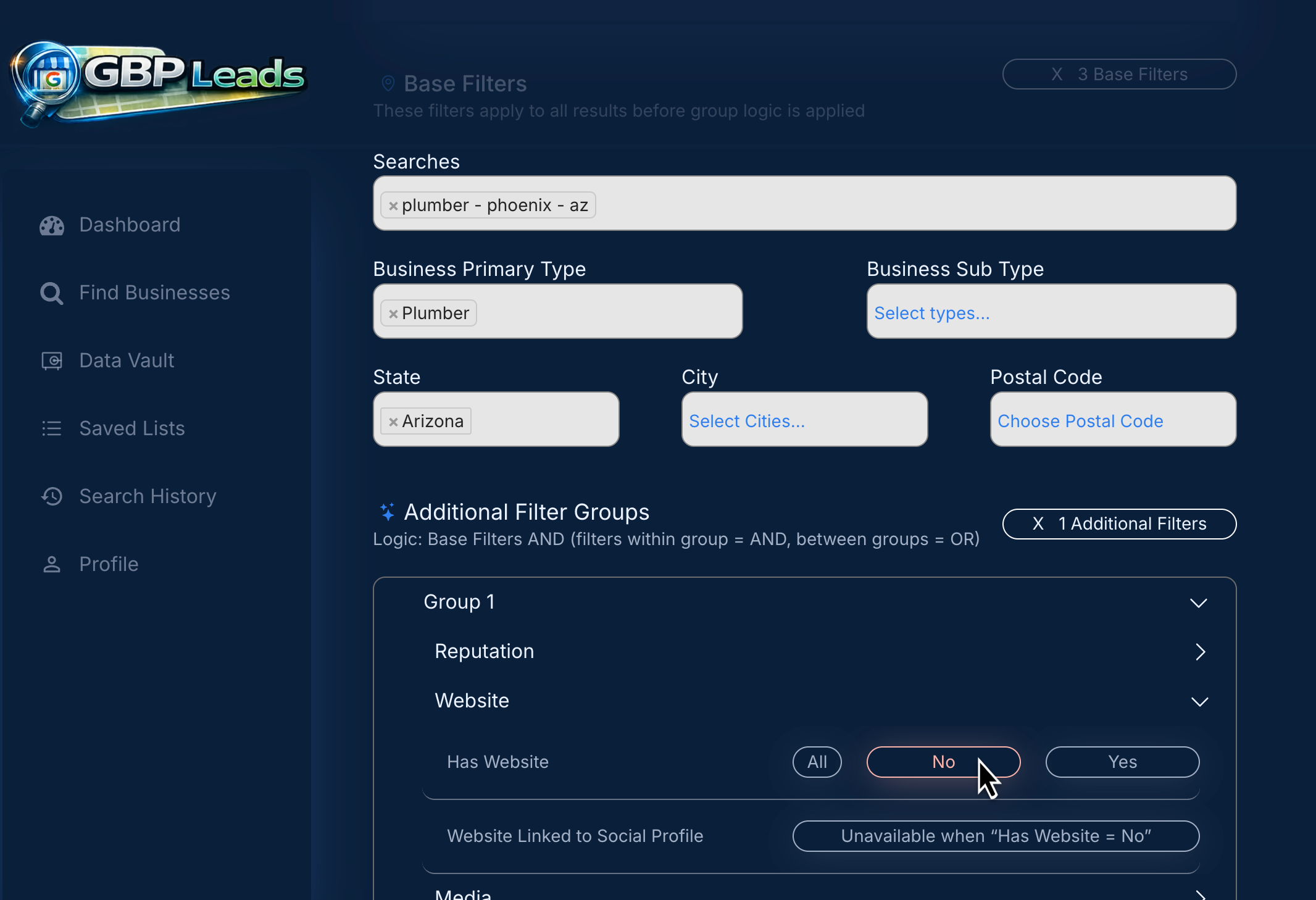
Want to skip the manual work? GBP Leads searches Google Maps, filters for businesses with no website, and gives you an export-ready lead list with contact details in minutes. Every search also grows your Data Vault so your list compounds over time. Try it free.
How to qualify a lead before you reach out
Not every no-website business is worth your time. A quick qualification pass before outreach saves you from chasing leads that will never convert. Run each prospect through this checklist:
Does this business type actually benefit from a website? A restaurant, contractor, dentist, or law firm clearly does. A business that runs entirely on wholesale contracts may not care.
Do they look like they can pay? A professional logo, active and recent reviews, and a steady stream of customers are all signals the business has revenue to invest.
Is contact info available? A reachable phone number or public email is the difference between a lead you can work and a name you can't act on.
Are they actually missing a website, or just missing it on Google? Do a quick search of their name to confirm there's no site you missed before you build the pitch around it.
Two minutes of qualification turns a raw list into a list worth working.
How to reach out (with a copy-paste template)
The outreach is easy because the problem is undeniable. Lead with the gap, make it visual, and offer value before you pitch. Here's a template that works for a no-website business, by email or DM:
Subject: quick question about [Business Name]
Hi [First Name],
I was searching for [business type] in [city] this morning and noticed [Business Name] doesn't have a website, while a few of your competitors do. When someone searches for what you offer, those competitors show up and you're harder to find.
I help local [business type] businesses get a simple, professional site up that brings in calls. No pressure at all, but if it's useful I'm happy to send over a quick example of what it could look like for you.
Either way, you've got a great reputation in [city] and I figured you'd want to know.
[Your name]
A few tips to personalize it so it doesn't read like a template:
Name a real competitor who does have a site. Specificity makes the gap concrete.
Reference something true about them, like their review count or how long they've been in business, so it's clear you actually looked.
Lead with value, not the ask. Offering a quick mockup or example converts far better than asking for a call in the first message.
Frequently asked questions
How do I find local businesses without a website?
Search Google Maps by business category and city, then check each listing for a missing website link. For volume, use a tool like GBP Leads that filters Google Business Profile data for businesses with no website and exports a clean, contact-enriched list in minutes.
What percentage of small businesses don't have a website?
Roughly 27% of US small businesses have no website, which is around 8 million businesses according to industry surveys and US Chamber of Commerce data. In service trades specifically, the share with no website is often higher, sometimes 40% or more.
Are businesses without websites good clients?
Yes, often the best. The need is obvious and easy to demonstrate, there's no incumbent agency to displace, and the build leads to recurring revenue from hosting, maintenance, and SEO. Value-first outreach to these businesses tends to convert better than chasing businesses that already have a site.
How do I find businesses without websites for free?
The free methods are manual Google Maps searches, Google search operators (like site:facebook.com queries), browsing directories such as Yelp and Yellow Pages for empty website fields, checking new state business registration filings, and local networking. They work but they're slow and don't export easily.
What is the fastest way to find businesses that need a website?
An automated Google Maps lead tool. GBP Leads searches by niche and location, filters for "no website," verifies each business is open, enriches contact data, and exports a CSV in about 30 seconds, replacing an afternoon of manual searching.
How do I contact a business that has no website?
Use the phone number or public email from their Google Business Profile, or message them on the social page they use instead of a website. Lead with the specific gap (no website while competitors have one) and offer value, like a quick mockup, before pitching.
Can I get a bulk list of businesses without websites?
Yes. GBP Leads lets you pull hundreds of no-website businesses across multiple cities and niches, filtered and contact-enriched, exported to CSV. Every search also adds to your Data Vault so your list grows and deduplicates over time.
Which industries are most likely to need a website?
Service trades top the list: plumbers, electricians, HVAC contractors, roofers, landscapers, and cleaners. Many are owner-operators who built their business on referrals and never prioritized a site. Restaurants, salons, and independent retailers in smaller markets are also commonly without one.
Final thoughts
Finding local businesses without websites used to be a grind: manual Google Maps searches, copy-pasting into spreadsheets, deduplicating by hand, checking if numbers still work. The manual methods in this guide genuinely work, and if you're just starting, use them.
But they don't scale. If you want hundreds of qualified, export-ready leads filtered by missing website, across as many cities and niches as you want, GBP Leads does it in minutes. Build your Data Vault, filter for no-website businesses, and start the conversations while your competitors are still clicking through Google Maps one listing at a time.
For more on the broader workflow, see our local business lead generation guide and our walkthrough on how to build your first lead list in 20 minutes. You can also target adjacent gaps, like businesses without social media and reputation management clients.